Ben Allfree
MeshEnvy Founder
View all authors

The Privacy Problem

· 5 min read

Ben Allfree
MeshEnvy Founder

MeshEnvy operates a public mesh across Nevada. The mesh is comprised of both MeshEnvy equipment and equipment supplied by individual community members. The mesh is open and anyone can extend it by adding their own equipment.

In order to reason about and understand the mesh, it is helpful for individual sites to share a name and location publicly. Then others can see where the mesh is dense, where it is sparse, and plan how to extend it. Without knowing where a certain site is located, it is more difficult to conduct legitimate mesh-building work. Builders have a reasonable basis for wanting site names and locations.
MeshCore Try CLI

· 3 min read
Ben Allfree
MeshEnvy Founder

We push MeshCore settings to field repeaters over the mesh. Most of the time that is fine. Sometimes you are tuning receive paths to save milliamps on a solar node and you wonder what happens if you push too far. A repeater that stops hearing you is a long drive.

set is permanent. MeshCore already has tempradio for a live RF experiment that clears on reboot, and hop.ignore for a volatile bench knob. Neither covers "try this pref for an hour, then put it back unless I commit."

Heltec T096 Solar Repeaters

· 5 min read
Ben Allfree
MeshEnvy Founder

Out in Nevada we cover a lot of empty ground with janknodes: repurposed solar-light enclosure, cell, repeater zip-tied to a fence post.

RAK4631 janknodes have been our keep-up proof. Field units hold about 4.0 V and have made forty-mile MeshCore hops with a stock SX1262 and no external amp. Twelve Heltec T096 janknodes sitting on the deck, built the same way, have not held voltage the same way. We did not run a bench meter campaign. We left them in the sun, polled battery voltage through the fleet tool, and changed two MeshCore settings that already exist on the radios.

Duty Cycle

· 4 min read
Ben Allfree
MeshEnvy Founder

A year ago I could not have told you what duty cycle meant. After spending time in the radio world, I understand it as the amount of time a radio is allowed to transmit per hour. A 50% duty cycle means the radio may use up to thirty minutes of transmit time in that hour. That is a ceiling, not a promise. If there is nothing to send, nothing goes on the air and no budget is consumed.

Remote Firmware Updates Over the Mesh

· 13 min read
Ben Allfree
MeshEnvy Founder

The hard part of a statewide mesh is not flashing a radio on a bench. It is changing firmware on a repeater you will not see again for months, over a link that is already busy carrying real traffic, without bricking the node or stepping on the mesh.

That is what mota is for. A .mota file is a self-checking firmware package that can travel over LoRa a kilobyte at a time. Neighbors advertise what they have. A node fetches the pieces it needs at the lowest radio priority we have. Nothing installs until someone says so, or until you have explicitly trusted a signer.

The original OTA design is vk496's. EnvyOS packages it with motatool, an apply bootloader we call EnvyBoot, and a release habit that matters more than any of the file formats: one delta from every prior fleet image, straight to latest.

Off-Tower Site Selection

· 4 min read
Ben Allfree
MeshEnvy Founder

Nevada is full of radio towers, from AlertWildfire cameras and mine sites to state DOT compounds and commercial repeaters. We partner with tower owners constantly and we are grateful for the access they give us. A tower compound is often the right place to start thinking about a site, and it is not always where we finish.

Privacy-First Routing

· 2 min read
Ben Allfree
MeshEnvy Founder

MeshEnvy operates a public mesh across Nevada. Privacy-first routing is how our backbone repeaters behave on the air.

MeshEnvy does not publicly disclose repeater names or locations. The coverage map shows where the mesh reaches, not individual node identities or coordinates, consistent with our privacy policy. Backbone repeaters run in privacy mode. They do not answer anonymous requests for site-identifying data.

ANDMan rescues a DorkNode

· 6 min read
Ben Allfree
MeshEnvy Founder

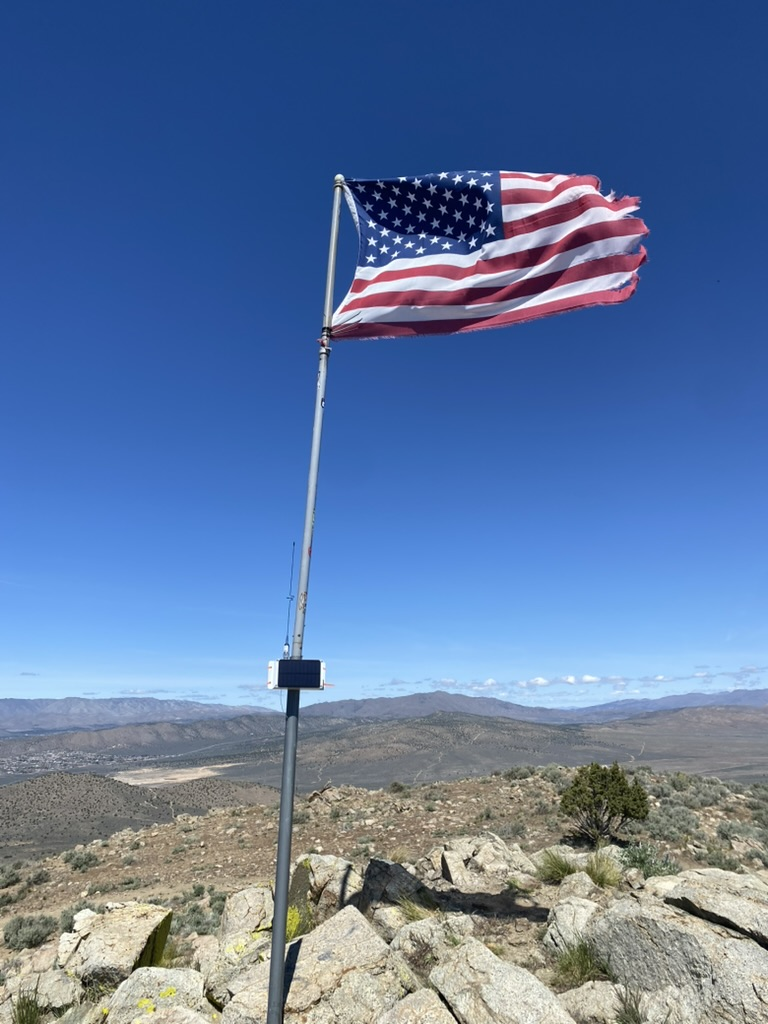
Today ANDMan showed up in Discord and asked whether a node he had found on Spanish Benchmark belonged to us. It did. ME0002, our second DorkNode deployment, orange zip ties and all, hanging on a flagpole above the Truckee Meadows rim.

The DorkNode enclosure is an adaptation of the MSPMesh design that Imperator recommended to Dork. Backplate, hose-clamp tabs, solar integration, the whole package. On my first trip up I did not have a backplate or hose clamps in the bag. Zip ties were what I had, and they got the node on the air.

It was my first time installing any kind of node. That is the whole zero to one thing we talk about so much. Get a live repeater on a summit first. Iterate later.

ME0002 on the Spanish Benchmark flagpole, orange zip-tie mount and tattered flag above the basin

Topaz

· 7 min read
Ben Allfree
MeshEnvy Founder

Mark Spencer lives in Coleville, down on the eastern slope of the Sierra where the mesh had never reached. We met at the Minden user-group summit about six months ago and kept in touch. His vertical antenna comparison is one of the more practical pieces on the site. In conversation he mentioned that Coleville still had no real mesh coverage and that he had once caught a brief glimpse of Meshtastic traffic, possibly from Mount Rose. That was enough for me. I offered to load up the Jeep and stake a node somewhere that could actually serve his town.

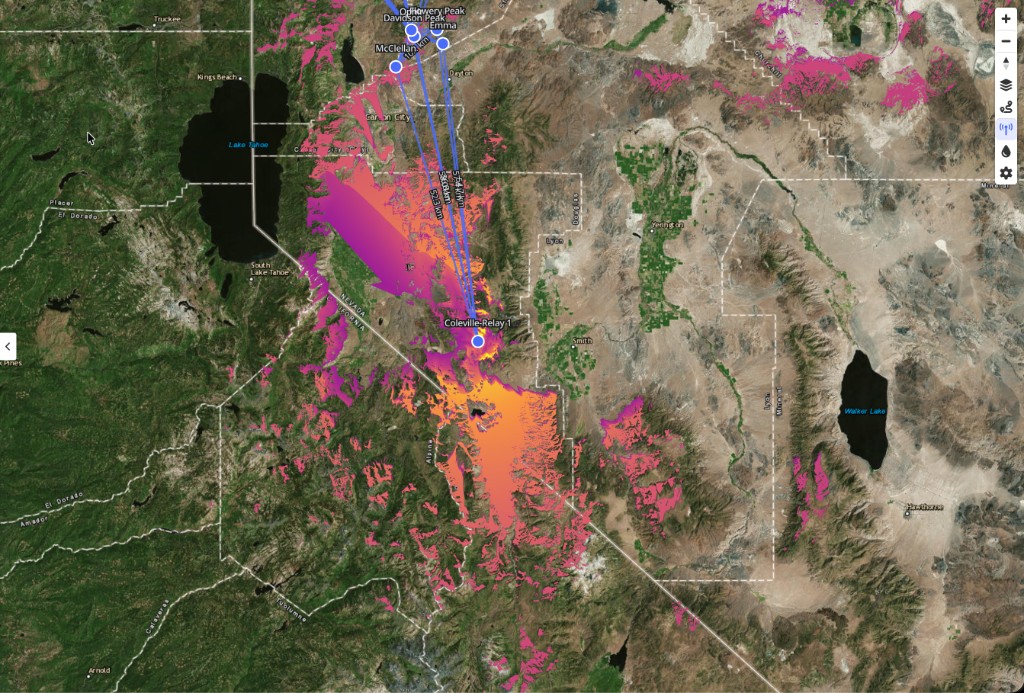
I fired up Peaky Finders and ran a goal-seeking pass toward Coleville. The algorithm pointed at Bald Mountain, a summit that already hosts ALERT wildfire cameras. From that ridge the model showed clean lines to McClellan Peak, Davidson Peak, and Flowery Peak above Virginia City. One well-placed repeater could light up Smith Valley, Coleville, Walker, and the whole Topaz Lake area. For the price of a single backbone node we could cover a basin that had been dark on our map. It felt worth a diversion from the other work on the calendar.

Peaky Finders coverage model from Bald Mountain toward McClellan, Davidson, Flowery, and Emma peaks

Silver Springs Earthquake

· 4 min read
Ben Allfree
MeshEnvy Founder

On the evening of April 13, 2026, a magnitude 5.7 earthquake struck near Silver Springs in Lyon County, about an hour east of Reno. Strong shaking rolled through Fallon, Carson City, and the Truckee Meadows. The USGS recorded more than two dozen aftershocks in the hours that followed.

While residents checked on neighbors and store aisles picked up the pieces, something else was happening on the air. The Nevada mesh network saw a sharp increase in traffic. Handheld nodes and repeaters kept passing messages through the event and its aftermath.